


Winter paragliding: tips & tricks
The snow has arrived in our mountains, and while most people are getting their skis out of the closet, others are still braving the cold under their glider. Indeed, many pilots are not deterred by the winter.
However, flying in winter conditions isn't always as easy as it is in the spring or summer. That's why we've put together a list of tips to help you enjoy the snowy landscapes with complete peace of mind!
First of all, why fly in the winter?
That's a good question! Why should we persist in facing the cold to go for a short flight when we could be warm under our blanket with a good book in our hands, or go for a ski or snowboard ride for the more daring.
In fact, flying in the winter has many advantages that you might not necessarily think of at first glance.
The conditions are mild and calm to...
… enjoy!
While it’s still possible to encounter thermals during the winter, they are less common and much weaker than during the rest of the year. As a result, paragliding in the winter offers less turbulent conditions—perfect for a series of flights that are 100% about enjoying the scenery!

... to improve your skills
At this time of the year, "less thermals" also means "shorter flights". What if winter taught you to love short flights again?
If a few-minute flight straight toward the landing site seems boring to you, remember that this is the perfect time to work on your technique.
Multiplying flights means that you will experience many take-offs and landings, giving you the luxury of varying your techniques to perfect them: reverse inflation, cobra... It is also an opportunity to practice maneuvers on flight : ears, pitching, speed range management... In short, the calm conditions of winter are a great opportunity to practice without being heckled by the thermals
During this season, you can also try out different activities: winter is known for offering great soaring conditions, for example, and it’s also the season for ski flying! In addition to being fun, these different paragliding activities are ideal for training and improving your piloting precision, so why not give them a try?

... renew your equipment
If you are planning to change your equipment, this is the right time to do it! Because winter is also the perfect time to get familiar with a new wing or harness.
Since the weather conditions are easier to anticipate, you can serenely accumulate flights to learn the behavior of your new equipment without fear of being surprised by big turbulences such as we could encounter in spring.
So, by testing your gear’s capabilities in mild conditions, you’ll be able to tackle spring with confidence—whether under a wing or in a harness—that you already know like the back of your hand!
…stay consistent
Not flying in winter is synonymous with a break from flying for several months. If you wait for the return of the warm weather to get back in the air, you risk losing your flying reflexes, or at least, the getting back under a wing will be more difficult than if you had practiced regularly during the winter.
In conclusion: Flying in the winter helps you stay safe under your wing and perform better in the spring!

Now, let's talk about equipment...
…Dealing with Snow
In winter, you will have to take-off and land on snow, or at least on wet ground, which will inevitably have an impact on your equipment if you do not take care of it properly.
If the simple contact of your wing with the snow should not be enough to wet it, pay attention to the small snow blocks that can slip inside the cells. When you get home, this snow melts and wets your equipment.
If the amount of snow in the cells is too important, the weight of the snow can deform the airfoil of your wing. If it happens to you, you may be exposed to an unintentional drift of the wing or an increase in the angle of incidence, which could lead to a stall or a spin if you use too much break.
That's why, before flying or folding, remember to check your cells for snow, and remove it if there is any.
Finally, taking off on snow can sometimes be tricky if the slope is a bit steep. In fact, the wing may tend to slide across the ground. To counteract this kind of problem, there are solutions to keep your wing in place, such as grip spikes. These are sold with mountain-specific wings like the EIKO2, these small accessories attach to the upper surface of the wing using a lark’s head knot. Then, all you have to do is stick them into the snow so the wing stays put despite the slippery terrain. The momentum you generate during takeoff to inflate your wing is enough to dislodge the stakes from the snow. Pretty handy, right?

The harness components aren't spared by the snow either! In fact, ice can sometimes get trapped in the carabiner mechanisms, which can then jam the locking system. For your safety, check that your carabiners are properly locked before every takeoff.
As with carabiners, some harnesses with automatic buckles require just as much care : if ice gets lodged in the Loops, the buckle may not close properly. Again, pay close attention when you buckle up.
When you get home, unfold your wing. If you don't have enough place to spread it out, unfold it into a ball or open the compress bag or sock your wing is stored in to help the fabric dry. It is important to store your wing in a dry place, at room temperature and away from light. Do not leave it drying next to a heater or in a damp basement, for example.
After a day of flight on the snow, also make sure not to store your harness in its bag if it is still wet. Indeed, it is never excluded that a block of snow slips into the harness during the pre-flight or when folding. To limit this risk, check the pockets of your harness and the airbag.
Finally, if you make a lot of takeoffs and landings in the snow throughout the season, it may be wise to check the e reserve parachute r as well. Although it’s normally protected inside its locked emergency pouch, it’s best to air it out and fold it up at the end of the winter season if you suspect that snow has gotten into the compartment.
… cleaning and maintenance
When it comes to equipment maintenance, it’s not uncommon to find a little dirt that might stain your gear if the ground is snowy or wet. If you want to clean these stains, a clean cloth and fresh water are all you need—be sure not to use any harsh cleaning products!
Also, keep in mind that repeatedly wetting and scrubbing a wing isn't good for the fabric either, as it can wear it down. So you don't have to clean every little stain as soon as you see one. Remember: a completely clean wing is a wing that doesn't fly!
Finally, snow and ice are two elements that can be very abrasive to your equipment. You should therefore take good care of your equipment by minimizing unnecessary friction against the ground and having it inspected regularly at an authorized service center.

What about flying with skis ?
Mixing skiing and paragliding is one of the joys of winter. When the pleasure of skiing is added to that of flight, one can only want to start practicing !
…two sports, two sets of skills!
If you've never tried ski flying before, keep in mind that you need to be proficient in both sports to practice safely. Knowing how to ski is just as important as knowing how to fly, and neither of these skills should be neglected.
…take care of your equipment
The edges of your skis are sharp and could damage your lines or the fabric of your gear if you aren't careful enough.
When you put on your skis for takeoff, be sure to keep the lines away from the bottom of your skis. The same applies when you land your wing or if it falls on you during a failed takeoff.
If you think you may have skied on the equipment by mistake, perform a visual inspection to make sure nothing has been damaged, and if in doubt, take it to a professional repair shop to have it checked.
Also, when flying on skis, pay attention to the flight equipment you choose to use. For example, it is not advisable to use a harness that can be threaded, as running ski boots or crampons through the legstraps could snag and damage the fabric.
Harnesses like the RADICAL4or the the EVEREST3have been designed so that the legstraps can be opened. This makes it easy to get into the harness , even in the mountains when you are wearing ski boots or crampons, and there is no risk of damaging the harness in this way.
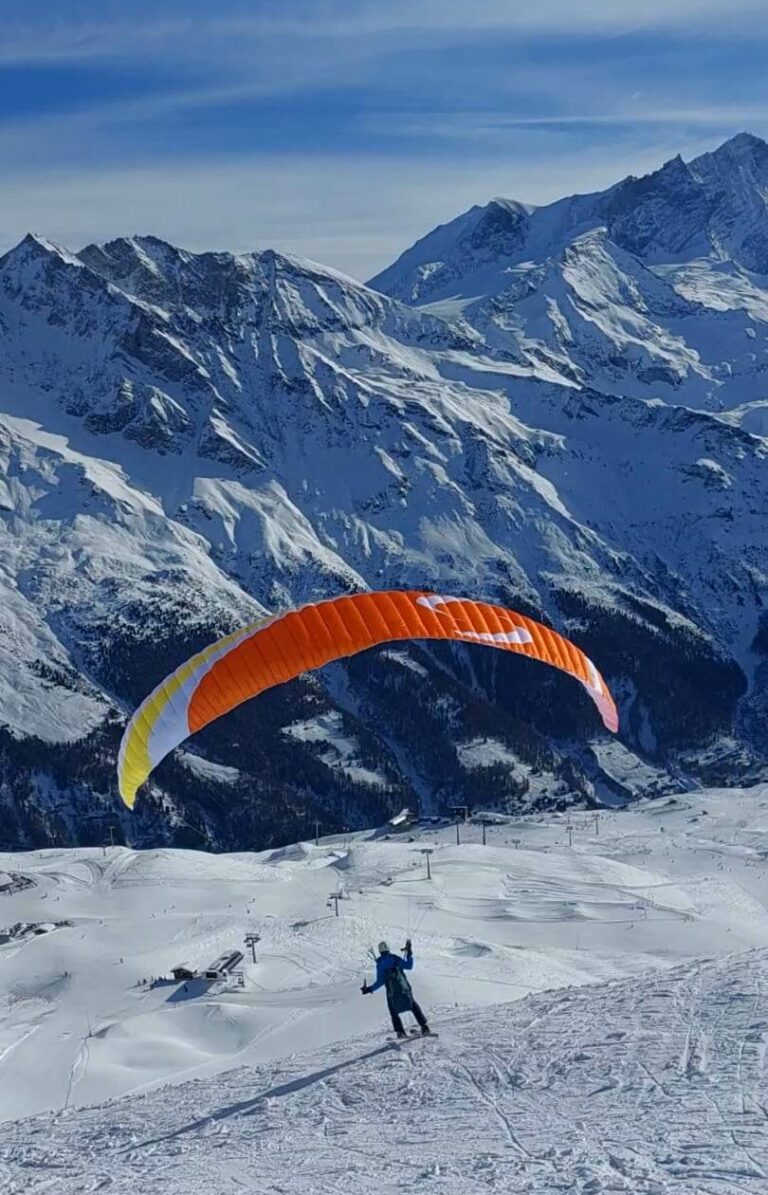
...pay attention to your environment
Except for those who like to ski touring, flight is most often practiced in ski resorts. If the rotations in ski lifts are convenient and comfortable, it is still necessary to pay attention to certain points:
Make sure your skis are strapped on properly! Unfortunately, it’s not uncommon to see a ski wandering off on its own up in the mountains after a pilot has lost it in mid-air.
If a ski falls off the trail, you might have a little trouble retrieving it, but it won't be a big deal. However, if you lose a ski over a busy area, the falling ski could cause property damage—or worse, injure someone.
While checking your flight equipment is essential, be sure not to neglect checking your ski gear either.
Next, when riding the ski lifts, be careful how you pack your gear! If a line or strap sticks out of your bag, it could get caught in the lift mechanisms, so be careful when packing your equipment…

Dressing warmly is essential
Although this advise seems obvious, it is not enough to multiply the layers to be comfortable in flight. The goal is to stay warm while maintaining mobility, whether it's during takeoff or in the air.
…protect sensitive areas
When flying, the extremities of your body are the most exposed to the cold: that is, your hands, feet, and face. But how can you properly protect them from the cold?
Using gloves that are too thick may reduce the feeling of tension in the controls, impacting your steering precision. In these cases, solutions such as heated gloves or sleeves down gloves are more advantageous to keep your hands warm while remaining efficient in piloting.
Next, protect your face! The mask and neckband combo works well for this. And if you have left space under your helmet, you might also consider wearing a beanie to keep your head and ears warm.

…stay warm and safe
Also, untangling your lines and setting up your equipment while wearing gloves that are too thick can be inconvenient during the preflight check. You may therefore want to consider bringing thinner gloves with you to use while setting up your equipment.
When it comes to your feet, there’s no magic solution: waterproof shoes and thick socks are the way to go. If you have a pod harness, don’t hesitate to use it during the winter! The speedbag provides an extra layer of protection between you and the cold, so why not take advantage of it?

We hope our tips and advice will help you fly with greater peace of mind, no matter the season!
So, are you interested in flying in the winter?

